You are releasing an album and facing the question that every independent artist asks themselves: a cardboard digipack or a classic plastic jewel case? The answer is not straightforward, as it depends on the print run, budget, and how you want the album to look on the listener's shelf.
- Material: digipack is made from 300 g cardboard, jewel case is a three-part plastic box.
- Print run: digipacks can be produced digitally from 10 pieces, jewel case makes sense only for larger quantities of pressed CDs.
- Cost: digipack can double the unit cost of the release compared to a simple jewel case.
- Appearance: digipack offers more space for graphics and embellishments, jewel case is more universal and predictable.
- Eco-friendliness: cardboard is easier to sort and recycle than plastic.
What is the difference between digipack and jewel case in terms of construction and materials?
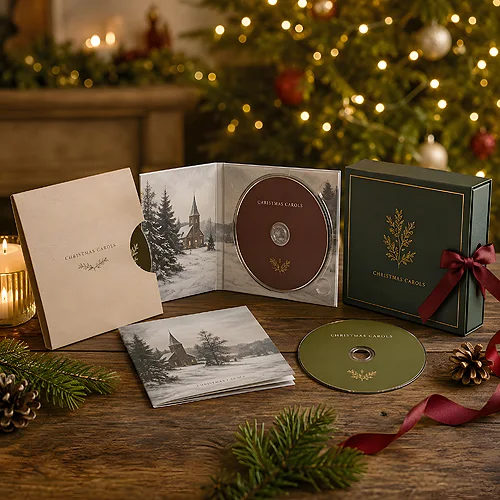
A digipack is an album packaging made of graphic cardboard, folded into panels, with a transparent tray on one of the wings. The most popular variant, 4P digipack, is 300 g cardboard, providing rigidity comparable to a hardcover book. The disk is held in a plastic tray glued to the cardboard, and the entire product opens like a small brochure.
The jewel case is a completely different philosophy. It is a rigid plastic box made of three components: two parts of the casing and a tray in the middle, with standard dimensions of 142 by 125 by 10 millimeters. Inside, it holds not only the disk but also a booklet (up to 24 pages) and an insert under the tray at the back of the packaging. There is also a Slim version, which is twice as thin as the classic one, popular for promotional releases or singles.
The material difference translates into the production method. Digipacks are printed directly onto the cardboard, so the entire surface of the packaging is a single coherent graphic. The jewel case requires a separately printed booklet, a separate insert, and the box itself, which is bought ready-made as a plastic component. It's somewhat like comparing hardcover and paperback bindings in books: one form is integrated, while the other consists of ready-made elements connected at the end of the process.
It's worth mentioning that digipacks come in several folding variants: 4P (single-fold), 6P (double-fold), and 8P (triple-fold), allowing for more than one disk or additional pockets for inserts. The jewel case does not offer such flexibility in format, although double versions for two disks can be purchased.
Digipack vs. jewel case: a comparison in numbers
Criterion Digipack Jewel Case Material 300 g cardboard Plastic (3 components) Minimum print run (digital) from 10 pieces depends on the supplier of boxes Minimum print run (offset/pressing) from 500 pieces from 500 pieces (for pressed disks) Unit price of packaging from about 30 groszy per piece usually lower than digipack Personalization high: foil, UV varnish, 4P/6P/8P variants limited to the booklet and insert Mechanical durability resistant to crushing, sensitive to moisture rigid but brittle upon impact Eco-friendliness cardboard, easy recycling plastic, harder recyclingDurability and protection of the disk: which one withstands transport and everyday use better?
Here, paradoxically, neither format wins outright, as each fails under different conditions.
The jewel case is rigid and protects the disk well from scratches as long as it lies calmly on a shelf. The problem arises in a backpack, in a courier package, or when someone sits on a bag with the disks. The plastic tray clips and hinges of the box break easily, and a broken jewel case is hard to repair; it simply gets replaced with a new one. Do you know that feeling when you open an old disk from the 90s and the hinge comes off in your hand? That's the flaw of this construction.
The digipack handles impacts and falls better, as cardboard does not break like plastic; it only bends or crushes at the corners. It performs worse when it comes into contact with moisture: spilled coffee or long transport in a damp box can soften the edges and detach the laminated cover. For postal shipments, it's worth additionally securing digipacks with shrink film or a bubble envelope so that the corners do not bang against each other in the shipping carton.
From the perspective of a record store or distributor, stacking also matters. Jewel cases stack neatly in rows on shelves and do not lose shape under the weight of other boxes. Digipacks in large stacks can slightly sag if the cardboard is thinner than the standard 300 g. If you plan on distribution in physical stores, it's worth considering this at the stage of paper weight selection.
If you are sending disks by mail to fans who order online, a digipack will better withstand uneven treatment by the courier than a jewel case. Just add appropriate protection in the package.
How much does production cost for a small and for a large print run?
This gets specific, as the costs diverge depending on the scale of the release.
For small print runs, below 500 pieces, digipacks and CD envelopes are available in digital printing from 10 copies, which is ideal for a debut EP or limited edition for a concert. Jewel case usually comes out cheaper in these quantities, but when completing a release (disk plus booklet plus insert), the cost of labor and materials quickly equalizes.
For larger print runs, the picture changes. CD pressing with print is available from 500 pieces, and this includes a matrix in the price, which only makes sense at scale, as the cost of the matrix spreads over all copies. A sample pricing of pressing shows how drastically the unit price drops: for 100 pieces, it's around 9.50 PLN per disk, for 300 pieces it’s 2.90 PLN, and for 1000 pieces it’s only 1.35 PLN. For a run of 500 pieces, the cost of pressing the disk is about 1.30 PLN; however, choosing a digipack or box set instead of a simple jewel case can double the unit cost of the entire release. This is important information for publishers planning their budgets: packaging can be more expensive than the disk itself.
Additionally, there is the cost of graphic design for the cover and visual identity of the album, which typically ranges from 1000 to 3000 PLN, depending on the graphic designer's experience. It is worth including this in the calculations from the start, as with a small print run, the cost of graphic design per piece can exceed the cost of printing itself.
Standard production time for digipacks, unipacks, and CD envelopes is up to 3 business days from project acceptance, which is significant when planning an album release, as it leaves a margin for any last-minute corrections.
Personalization and visual impressions: what resonates more with the listener
The digipack simply offers more room for creativity. The 4P, 6P, or 8P panels provide several printed surfaces that can be used for separate graphics, lyrics, or acknowledgments. Moreover, there is the possibility of applying glossy or matte foil and selective UV coating, which highlights selected elements of the cover, such as the band's logo or the album title. This format was patented by MeadWestvaco, and today the prices for such packaging start from about 30 groszy per piece, depending on the print run and supplier, showing that elegance does not necessarily mean high unit costs for larger runs.
The jewel case offers less maneuvering room, as all customization is limited to the booklet (up to 24 pages), the front insert visible through the plastic, and the back card under the tray. It’s a tried-and-true format, recognizable, but it’s hard to surprise anyone with it. If you want the album to look like a collector's item rather than a standard label product, the digipack wins without a doubt.
It’s worth thinking about the cover similarly to the selection of materials for other corporate prints: the choice of appropriate weight and finishing can change the perception of the entire product, just like with the choice of paper weight for business cards and leaflets, where thicker paper automatically suggests higher brand quality. With a digipack, this principle works the same: heavier cardboard and careful finishing create a premium impression even before someone puts the disk into the player.
If you're looking for inspiration for your own cover layout, it's worth checking out services that gather independent visual creators, as a well-designed music release is not just about sound, but also a cohesive graphic identity visible on every panel of the packaging.
Which format is more ecological: digipack or jewel case
Cardboard outperforms plastic in most recycling-related scenarios. The digipack goes into the same waste stream as other paper packaging, and its production allows for the use of eco-friendly variants, such as those based on kraftliner, a raw material with fewer bleaches and chemicals in the production process.
The jewel case is pure plastic, usually polystyrene, which in theory is recyclable, but in practice rarely ends up in the right container, as consumers do not always know it's a separate waste category from regular plastic packaging. Additionally, the fragility of the material plays a role: a broken box most often ends up in the trash, not in the recycling system.
From the perspective of a publisher thinking about brand image, more and more independent labels and bands choose digipacks for environmental reasons, as the information "packaging made from responsibly sourced cardboard" looks good in the product description on Bandcamp or in the band's online store. This is not just marketing; although it does have a branding dimension, it is a real difference in the production's carbon footprint.
If you plan a seasonal print run, such as a limited edition for the end of the year, it’s worth thinking about the production schedule similarly to planning other seasonal materials, where the key is anticipation, not last-minute haste. Just like with the choice of corporate calendar format, where the decision on format is made much earlier than the actual printing, it’s wise to reserve time for choosing an eco-friendly cardboard variant for the digipack before production starts.
Digipack or jewel case: our recommendation
If you are releasing a debut album in a print run of up to several dozen pieces, for concerts or direct sales to fans, a digitally printed digipack is the better choice: flexible print runs from 10 pieces, short delivery time, and greater personalization possibilities favor its use.
If you are aiming for a large print run, retail distribution, and a classic, predictable look for the CD, the jewel case pressed from 500 to 1000 pieces offers a lower unit cost and a tested, stable package that will not surprise the distributor with an atypical format.
There is no one correct answer, as it is a question of priorities: budget, visual prestige, or logistics. For many independent publishers, a compromise is to release part of the print run in digipacks as a limited edition and the rest in standard jewel cases for wider distribution.
Frequently Asked Questions
Is a digipack more expensive than a jewel case?
Usually yes, especially considering embellishments like foil or UV varnish. Choosing a digipack instead of a standard jewel case can double the unit cost of the entire release, although the difference decreases with larger print runs.
From how many pieces does it make sense to order digipacks?
Digipacks in digital printing are available from 10 pieces, making them profitable even for very small, collectible print runs. Offset printing starts only from 500 pieces, and then the unit cost clearly decreases.
Which format withstands postal shipping better?
The 300 g cardboard digipack handles impacts and crushing better than the brittle plastic jewel case, whose hinges break easily during transport. However, it’s worth additionally protecting the digipack from moisture during longer shipments.
Can the jewel case be personalized as much as the digipack?
The limitation lies in the construction itself: personalization of the jewel case mainly concerns the booklet of up to 24 pages and inserts, while the digipack offers the entire surface of the cardboard for printing and finishes like foil or selective varnish. If you want a unique look, the digipack provides more options.