Paper weight sounds like a technical parameter that should only concern printers. In practice, it determines whether a business card looks solid, whether a flyer wrinkles in the pocket, and whether a poster maintains its format in the wind. We show you how to choose it consciously instead of guessing.
What is paper weight and how does it affect print reception?
Paper weight is the weight of one square meter of paper, expressed in grams (g/m²). Nothing more and nothing less. Office paper usually weighs 80 g, and a solid business card can weigh up to 400 g. The difference in touch is enormous, even though the difference in number seems small.
Why does it matter at all? Because paper is not just a carrier of ink; it is also a message. A thin, translucent flyer suggests something temporary, disposable, perhaps even a bit tacky. Thick, stiff paper gives a sense of durability and weight, both literally and metaphorically. A client holding a 350 g business card subconsciously evaluates a company differently than one printed on paper as flexible as a napkin.
Paper weight also affects purely technical parameters: stiffness, resistance to creasing, how it behaves in the printing machine and after folding. Very thin paper (below 100 g) is translucent, which is a problem for double-sided printing with intensive graphics. Very thick paper (over 300 g) requires different scoring before folding; otherwise, it cracks along the crease.
It’s also worth remembering that weight is not the only parameter of paper. The same weight can be achieved on glossy, matte, offset, or decorative paper, and each reflects light differently and absorbs ink differently. Therefore, selecting the weight is always the first step, not the last. The next is choosing the type of surface, more about which can be read in the material on materials and papers used in printing.
- 80-100 g is office paper and internal pages of newspapers, too thin for representative materials.
- 130-170 g is the market standard for flyers, economical and sufficiently opaque.
- 170-250 g is for posters, catalog covers, folded brochures.
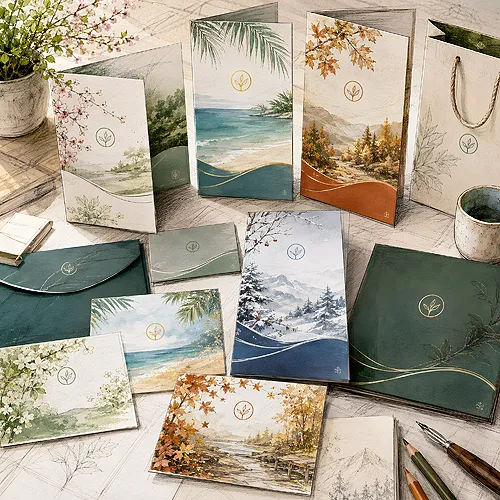
- 250-350 g is for business cards, invitations, greeting cards.
- 350 g and more are premium materials, where first impressions in touch matter.
Paper weights for ephemeral materials: from posters to brochures
A flyer is often the first contact of advertising material with the recipient, so choosing the weight can be a compromise between cost and quality of reception. Analysis of nearly 7000 flyer orders shows that almost half of clients choose 130 g/m² as an economical and proven solution. This paper is thick enough not to let the print from the other side show through, yet light enough for mass distribution, dropping into mailboxes or handing out on the street.
If a flyer is to represent a more premium brand, for example in the beauty industry, high-end gastronomy, or expert services, it’s worth considering 170 g. That already provides a distinctly different touch, less susceptible to creasing in a bag or wallet.
When a flyer is to be folded (in half, in three parts), a weight above 170 g/m² requires scoring before folding. Without this procedure, the glossy paper simply cracks along the crease, revealing white fibers, which looks sloppy even with an excellent graphic design. This is one of those technical details that designers may not know about, but which decide the final effect.
Posters operate under slightly different rules. For larger formats, a weight of 170-250 g is best, as the poster needs to be stiff enough not to roll up on a bulletin board or in a shop window, but it also cannot be so heavy that it causes problems when hanging with double-sided tape. The range of 170-200 g is often indicated as the optimal balance point. Thicker sheets, over 250 g, are reserved for posters that are mounted rigidly, for example, with a rail or hook, where the paper itself serves as a carrier. Company brochures and catalogs usually fall within the same range as posters, although the cover can be thicker than the internal pages. Before deciding on the format and weight, it’s worth taking a look at the complete offer of flyer printing, where you can see how different parameters translate into specific applications.
Thick and stiff paper: business cards, invitations, greeting cards
This is where the real game for first impressions begins. A business card held for three seconds can tell more about a company than a website viewed for a minute, which is why saving on weight in this segment can be a costly image error.
The minimum weight worth considering for business cards is 250 g/m², but the realistically recommended range is 300-350 g/m². Such paper provides the right weight, resists bending in a wallet, and does not give the impression of being "just paper." Weights above 400 g/m² are reserved for premium lines, where this moment of handing the business card to another person counts. It’s worth adding that the most commonly chosen weight on the market remains 350 g, as it offers the best balance between stiffness, durability, and reasonable production cost.
Invitations, such as wedding invites, operate under similar logic to business cards, although the weight of the entire set comes into play here. The paper weight for invitations should be at least 250-300 g/m², ensuring an elegant, stiff appearance without the risk of the card bending in the envelope. It’s worth remembering that a single invitation on 250 g paper in A5 format weighs about 9 grams, while the entire set with an envelope, inserts, and extras can weigh 20-40 grams, which is significant for postage and stamp selection.
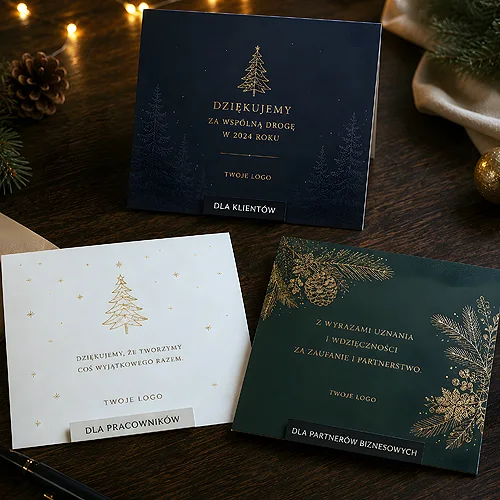
Similar rules apply to greeting cards, including company holiday cards sent to clients and business partners. Here, too, a weight of 250-300 g works, as such a card should land on the recipient's desk and stay there longer rather than get lost in a pile of correspondence. If you plan to send such a mailing, it’s good to plan it in advance, as the holiday season at printing houses can be busy. More about the schedule for such orders can be found in the article on when to order printing of holiday cards for businesses to be on time.
It’s also worth taking a look at costs in practice: for one hundred business cards on 350 g/m² paper in a standard format of 90x50 mm with double-sided printing, the price starts from several dozen zlotys, and simple business cards on basic paper can cost even less for a hundred pieces. The price difference between 250 g and 350 g can thus be small, but the difference in reception is enormous. This is one of those cases where saving a few zlotys on a hundred pieces simply isn’t worth it.
If you are hesitating between two weights for business cards or invitations, order samples on both papers instead of deciding based solely on the specifications. The touch and stiffness in hand tell you far more than the number on the label.
Weight and finish: how UV varnish and laminate change the perception of paper thickness
Here, many clients are surprised. The same paper, for example, 300 g, can feel completely different in thickness depending on what enhancement has been applied to it.
Laminate, whether matte or glossy, adds an additional very thin layer of foil to the paper. The effect is twofold: first, the paper becomes stiffer because the laminate stiffens the fiber structure. Second, the tactile feel changes: matte laminate gives the impression of a more premium paper, even if the base weight is not high. Therefore, a 300 g business card with matte laminate can feel heavier and more solid in hand than a 350 g business card without any finish.
UV varnish works a bit differently. Applied selectively or over the entire surface, it adds contrast and shine in selected areas, such as on a logo. It does not drastically change the stiffness of the paper but affects the perception of quality, as it creates a clear contrast between textures, a shiny logo on a matte background. This is a trick often used where the base weight is moderate, and one wants to achieve a premium effect without raising the cost of paper.
It’s also good to know that some enhancements only make sense from a certain weight upwards. Embossing, laser cutting, or deep scoring require paper that is sufficiently thick not to be damaged during processing. Attempting to emboss a pattern on 130 g paper simply won’t work, the paper will tear or the texture will disappear after a few days of use.
From a practical standpoint, this means that choosing the weight and choosing the finish must be planned together, not separately. If the budget is tight, sometimes it’s better to go down one weight grade and add laminate rather than invest in the thickest paper possible without any enhancement. The final effect can be surprisingly similar at a different cost. Before the final order, it is also worth verifying the chosen combination on a test print to avoid disappointment upon receiving the entire batch, as discussed in the section regarding trial prints before production.
Most common mistakes when choosing weight and how to avoid them
Some mistakes happen often enough that it's worth listing them directly, rather than wrapping them in generalities.
- Copying weight from someone else's project without checking the context. Just because the competition prints flyers on 170 g does not mean that the same weight will work in your case. Format, distribution method, and budget determine the choice, not trends.
- Using paper that is too thin for materials meant to last longer. A business card, invitation, or company card on paper below 250 g gives the impression of being makeshift, even if the graphics are well done.
- Using paper that is too thick where mass distribution is needed. A 300 g flyer handed out at a festival is unnecessary cost since the recipient will crumple it in their pocket within minutes.
- Ignoring scoring for thicker, folded materials. Paper over 170 g folded without prior scoring simply cracks along the crease.
- Forgetting about weight for postal mailing. Invitations or greeting cards sent in larger quantities can significantly burden the budget for shipping if the paper weight and extras (envelopes, inserts) were not calculated beforehand.
- Deciding based solely on the number without checking a sample. Weight is only one parameter; the texture and type of paper make a difference as significant as the weight itself.
How to avoid this in practice? Most simply: first determine the function of the material (whether it is to be distributed en masse or handed out individually), then the method of distribution (mail, hand-to-hand, display), and only then look for a specific weight. If the material goes directly to the client and is meant to represent the brand, such as a business card or company holiday card, it’s better to aim for the upper limit of the recommended range. For mass print runs and short durability, such as a promotional flyer, saving on weight makes sense. A good practice is to also use a ready-made guide when placing your first order, such as the material on how to order printing step by step, to ensure no specification steps are missed.
Frequently asked questions
What paper weight is suitable for business cards?
The recommended range is 300-350 g/m², though the minimum acceptable value is 250 g/m². Weights above 400 g/m² are considered premium lines, dedicated to materials meant to particularly resonate in touch.
Should flyers be printed on thick paper?
Not necessarily. The market standard is 130-170 g/m², sufficient to ensure print does not bleed through while still being economical for large quantities. Thicker paper, 250-300 g, is more appropriate for representative brochures than for mass distribution.
What weight is suitable for posters?
The optimal range is 170-250 g/m², specifically 170-200 g for regular hanging posters without additional mounting. Thicker sheets above 250 g make sense for posters that are mounted with a rail or hook, where the paper needs to maintain its own form.
Can laminate replace higher paper weight?
Partially yes. Laminate stiffens the paper and alters its tactile perception, allowing a material with lower weight to feel thicker. However, it will not fully compensate for the weight difference with very thin papers.
What weight should be chosen for invitations and greeting cards?
The range of 250-300 g/m² is effective, providing stiffness and an elegant appearance without overly burdening the envelope. For larger sets with inserts and extras, it’s worth calculating the total weight of the shipment immediately.