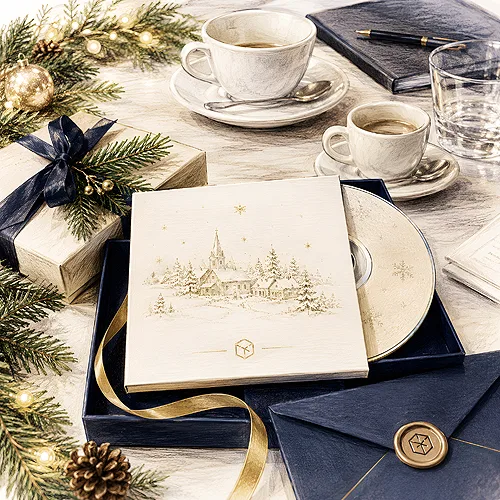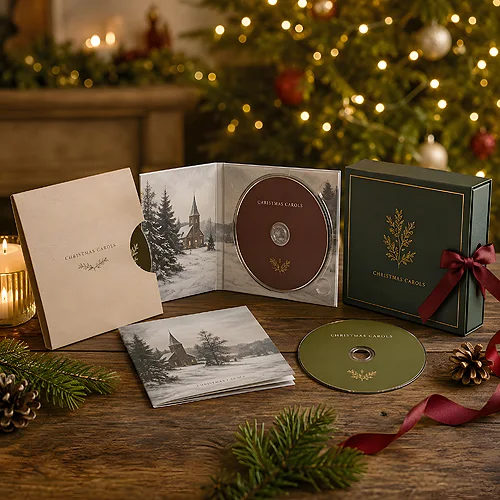
A carol disc can be a small pleasant gesture or a gift a client remembers for years - and the difference is often made not by the music itself, but by what it is dressed in. The packaging is seen first, before the first note sounds. It is what tells the recipient, in a fraction of a second, how much heart went into the gesture.
You usually have three routes to choose from: a light cardboard sleeve, an elegant digipack and a representative gift box. Each of them suits a different standing of gift, a different budget and a different way of shipping. Below we show how to match the packaging of a festive disc so the form works with what you want to convey - and to whom.
- Packaging communicates the value of the gesture before the recipient hears the music - the form makes the first impression.
- A cardboard sleeve is the eco, light and economical option, ideal for mass, warm gifts.
- The digipack is elegant, has a large print area and is the most often chosen - the golden mean between cost and prestige.
- A gift box is the most representative option, for a premium gift to key people.
- The festive print should be coherent between the disc and the packaging - one motif carried through the whole.
- Match the form to the way of shipping too: light packaging simplifies the logistics of larger runs.
Packaging speaks before the music sounds
Before the recipient puts the disc into the player, for a few seconds they hold only the packaging in their hands. And it is exactly those seconds that decide the first impression. A soft sleeve communicates something different from a rigid digipack, and a gift box something different again. The form is a quiet message: it shows how much attention went into the gesture.
That does not mean the most expensive packaging is always the best. It is about matching - a festive trinket for a wide group of clients follows different rules from an exceptional gift for the most important partner. A well-chosen form makes the gesture look considered, not overdone nor dismissed with just anything. For more on how the arrangement and presentation of a product affect how it is received, see our post on the arrangement of a product in a box and perceived value.
Before you choose the packaging, answer one question: is this disc meant to be a pleasant trinket for many people, or an exceptional gift for a few? The answer immediately narrows the choice and protects you from overpaying where a simpler form is enough - or from saving where prestige is what counts.
Cardboard sleeve - eco, light, economical
The cardboard sleeve is the simplest route: light, minimalist and environmentally friendly. It works wherever a warm gesture at a larger scale matters more than luxurious framing. It has a natural, slightly rustic charm that goes well with the intimate character of the holidays.
- Low weight - simplifies and speeds up shipping, especially for larger runs to many recipients at once.
- Eco character - cardboard is a material that easily fits the image of a brand that cares about the environment.
- Room for print - the front of the sleeve is great for festive graphics and a discreet logo.
- Economical at scale - for large quantities it is the form that lets you gift a wide group without giving up on aesthetics.
The sleeve is a good choice when you want to reach many clients at once with a warm gesture, and its lightness will be appreciated by anyone handling the packing and shipping of the whole run. If you want to compare different forms of the medium and packaging, it is worth looking at the discs and packaging section.
Digipack - the elegant golden mean
The digipack is the most often chosen form of disc packaging - and not without reason. It joins the elegance of a cardboard cover with a large surface on which festive graphics can truly unfold. It is rigid, pleasant to the touch and looks like a proper music release, not a leaflet with a disc inside.
Its greatest advantage is the space for the design. A fold-out digipack gives several panels on which you can fit a festive motif, a logo, short wishes, and sometimes even a track list. This makes the packaging itself part of the gift - something nice to pick up and look at before the music is heard.
When the digipack is the best choice
The digipack works wherever you want an elegant effect without stepping into the top shelf. It is a natural choice for company carol discs for clients and partners, when you want the gift to look refined while staying practical to ship. A fold-out digipack gives more room for festive artwork than a sleeve, and you will find the full offer of this form in the digipack section. For more on the differences between this form and simpler packaging, read our post digipack or CD sleeve - which packaging to choose.
Gift box - the most representative
When the disc is to go to a key partner or be a premium gift, you reach for a gift box - put together separately, outside the disc release itself. It is the most representative form - solid, refined, making an impression the moment it is handed over. Opening such packaging is itself a small ritual that raises the standing of the whole gesture.
- A sense of exceptionality - a rigid, careful box signals at once that this is a considered, individual gift.
- Room for the whole - beside the disc, the box fits a personal dedication, a small extra or a card with wishes.
- Prestige in the handover - this form works best when the gift is given in person, at a meeting or during a holiday visit.
A gift box is the choice for situations where what matters is not the number of recipients, but the strength of impression on a few of the most important people. You will make the most of its representative character where the relationship is exceptional and you want to underline it through the form.
Coherent print and ease of shipping
Whatever form you choose, two things are worth thinking through from the start: how the print links the disc with the packaging, and how the whole thing travels to the recipient. These often decide whether the gift looks buttoned up and whether it arrives without trouble.
Visual coherence makes a huge difference. When the same festive motif appears on the disc and on the packaging, the whole thing looks lovingly planned, not gathered from random elements. It is worth setting one motif - the palette, the graphics, the way the logo is placed - and carrying it through all the surfaces. The materials and papers page will advise on choosing the base and finishes, and if you are preparing files for print, take a look at the file preparation section.
The second matter is logistics. The larger the run, the more strongly the weight and dimensions of the packaging affect the ease and cost of shipping. Light sleeves and flat digipacks pack easily and quickly, gift boxes need more care but go to a narrower, selected group. It is worth reconciling the standing of the gesture with the realities of delivery. We develop the differences between packaging built for shipping and packaging for presentation in our post on the differences between shipping and gift packaging.
How to choose step by step
The choice of packaging is easier to make once it is broken into a few simple questions. Instead of starting from the form, start from who the recipient is and what character the gesture should have.
- Define the group of recipients - a wide client base or a few key partners? This first decision narrows the choice the most.
- Set the standing of the gesture - a warm trinket, an elegant gift or a premium present? A different form suits each standing.
- Check the realities of shipping - count the weight and the way of delivery for the planned run before you decide on the form.
- Plan a coherent print - choose a festive motif shared by the disc and the packaging, so the whole looks considered.
There is no single best packaging for a carol disc - there is the packaging best matched to what you want to convey. A sleeve will warm many recipients, a digipack will join elegance with good sense, and a box will make an impression where every detail counts. Match the form to the standing of the gesture, take care of a coherent festive print - and your disc will sound at the recipient's home as good as it looks.