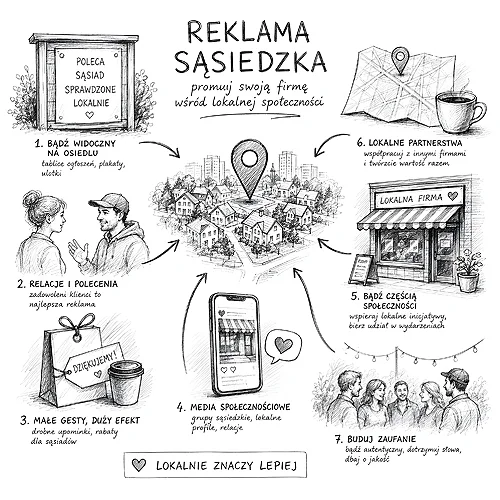
There is a moment when a new customer walks through the door and says: "I saw your flyer in my mailbox" or "I pass your sign every day on my way to work". That is no accident - it is the effect of advertising that works within a radius of a few streets. A small business does not have to fight for the attention of a whole city. It only needs to become recognisable where its customers actually are - in its own neighbourhood.
Neighbourhood advertising is a simple idea: instead of scattering your message across a whole region, you aim it at the people who live and work nearby. A hairdresser, a florist, a garage, a clinic, a small eatery or a corner shop gain the most from a customer who is close by. And for that customer to choose you, they first have to associate you with something - a name, a colour, a slogan.
Below we show how to build that recognition step by step - from choosing your tools, through working with neighbours, to the one thing that decides the outcome: regularity.
- Neighbourhood advertising is about building recognition within a few streets, not across a whole city.
- The foundation is print close to the recipient: flyers to mailboxes and handed out locally, plus posters in local spots.
- A consistent visual theme - the same colours, logo and slogan - is what makes residents start recognising the brand.
- Nearby, non-competing businesses are natural partners for joint distribution and mutual referrals.
- Regularity beats a one-off push - several smaller waves work better than one big drop.
Why the district scale works in your favour
Big campaigns take on the whole market at once and need serious budgets to break through the noise. A neighbourhood business plays in an entirely different league - and that is its advantage. Within a few streets you have a specific, countable group of people who can genuinely walk in. You do not have to convince someone from the other side of town that a detour is worth it. You have to remind a neighbour that what they are looking for is right next door.
Proximity also builds trust. People more readily choose local places they know by sight, pass every day and associate with the area. Neighbourhood advertising plays exactly that note - instead of building anonymous reach, it builds familiar presence. The effect does not appear after one contact, but after several, once the business name stops being unfamiliar and becomes part of the district's landscape.
Flyers - the foundation of neighbourhood advertising
The flyer is the simplest and most flexible tool at this scale. You can drop it into mailboxes on specific streets, leave it on the counter of a friendly neighbour, or hand it to passers-by at the hours when the area is alive. Classic advertising flyers work best here, because they are handy, economical in larger runs and easy to hand out in several waves.
The secret is keeping the flyer out of the bin. Specific, local content helps - an address the recipient will recognise, a reason to visit right now, a clear next step. Form matters too: a readable layout, one main message and decent paper make a difference. You will find more on designing something that lasts in our post on how to design a flyer the customer keeps for later.
Split the district into smaller zones and hand out flyers in waves, not all at once. The same mailbox that receives your material every so often will remember the brand far better than one that got a single flyer and then silence. A regular, smaller run beats a one-time burst.
Posters in local spots
Where a flyer reaches one person, a poster works on many at once. The area has plenty of places where people pause for at least a moment: community notice boards, the windows of friendly shops, cafes, clinics, gyms, service points. A well-designed advertising poster in such a place reminds dozens of people about the business every day, with no extra effort on your part.
A poster at this scale follows a simple rule: it must be readable from a few steps away. A large, unambiguous message, a strong brand colour and only as much information as the eye can take in at a glance. Leave the details, address and specifics to the flyer - the poster is there to catch the eye and plant an association. It is worth asking nearby spots whether you can put one up; plenty of local places happily agree, especially when you return the favour.
Neighbouring businesses - allies, not competition
The most underrated tool of neighbourhood advertising is other businesses in the area. If you are not taking each other's customers, you have every reason to work together. A florist and a bakery, a hairdresser and a beautician, a garage and a car wash, a cafe and a bookshop - each of these pairs serves the same residents, just from a different angle.
The forms of cooperation are simple:
- Swapping flyers on the counter - your materials at your neighbour's, theirs at yours.
- Joint distribution - a single mailbox campaign you share the print run for.
- Referral by hand - "here, the place next door does this brilliantly" means more than any advert.
The same mechanism works in sales too: a small piece added to a purchase can remind people of the business and build loyalty. We describe how to play it in our post on flyers tucked into parcels - the same logic applies when your material travels alongside a neighbour's product.
A consistent visual theme and regularity
All these tools truly click only when they look like one coherent whole. The same colour, the same logo, the same slogan on the flyer, the poster and the material at your neighbour's - it is precisely through repetition that the brain begins to recognise a brand. Change the style every time, and you build recognition from scratch. Keep one theme, and every further contact adds to the same association.
The other half of success is regularity. Neighbourhood advertising is not a one-weekend campaign - it is a presence spread over time. Several smaller flyer waves, a poster that hangs for weeks, a piece at your neighbour's sitting on the counter for months - it all adds up to the impression of a business that is simply here to stay. If you are wondering how to combine this print with an online presence, our post on whether print or online advertising gives better results will help.
Promotion at district scale needs no grand flourish - it needs consistency. Choose a few streets that matter to you, prepare a coherent set of materials, come to terms with your neighbours and return to residents regularly. After a few such waves, your business name will stop being one of many and become the familiar one, just around the corner - and that is exactly the moment when neighbourhood advertising starts working for itself.