Eco-friendly paper is becoming increasingly popular among companies that want to strengthen their image as sustainable and environmentally-friendly enterprises. The choice of the right paper, especially recycled paper, can significantly affect the quality of company materials and how customers perceive the brand. Discover the differences between recycled paper and FSC-certified paper, and see how these choices translate into communication and image.
How does recycled paper differ from FSC-certified paper?
Recycled paper is paper made entirely from recycled materials, such as used cardboard, newspapers, or leaflets. The recycling process allows for maximum use of raw materials, reducing the demand for fresh wood fibers. Eco-friendly paper typically contains a high percentage of recycled fibers, often 80% or even 100% post-consumer waste, which effectively relieves the environment.
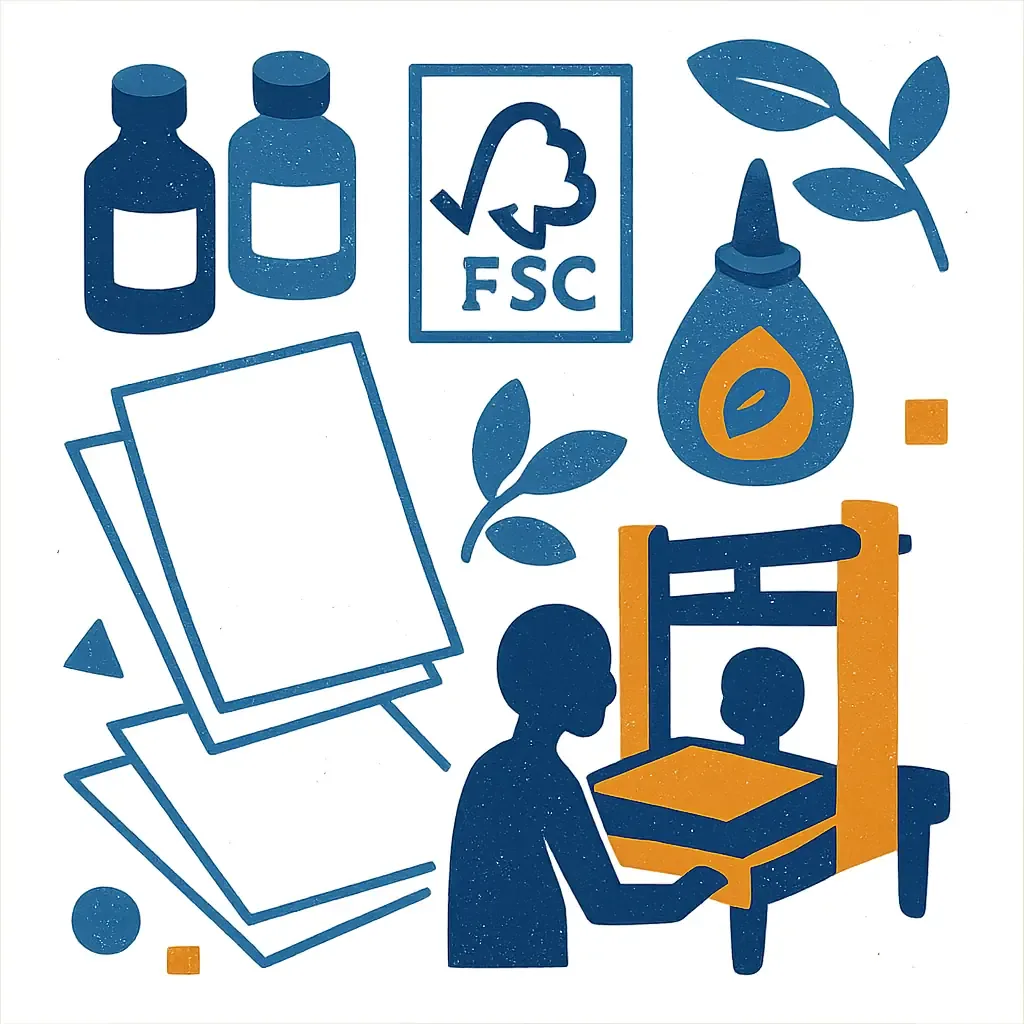
On the other hand, FSC-certified paper guarantees something different: the raw materials used for its production come from responsibly managed forests. FSC Recycled means that the entire product is made from recovered materials, while FSC Mix allows a mixture of wood from certified forests, recycled materials, and what is known as controlled wood. These are two different philosophies: one says "do not cut new trees," while the other says "cut responsibly where we must."
Currently, there are over 2,500 FSC certificates in the supply chain in Poland, which represents a 65% increase compared to 2017 and places Poland third in the world, behind China and Italy. As of now, 14 out of 17 regional directorates of the State Forests hold FSC certification. This shows that the market for certified raw materials has matured enough that printers can freely offer it to clients without driving prices up to absurd levels.
- Recycled paper - made entirely from secondary raw materials, reducing the demand for new resources.
- FSC certification - ensures that the wood comes from responsibly managed forests.
- FSC Recycled vs FSC Mix - the former is pure recycling, while the latter allows a mixture of raw materials.
How does the choice of eco-friendly paper affect brand image and communication?
More and more companies pay attention to selecting materials that reflect their approach to the environment. Using eco-friendly paper, whether recycled or FSC-certified, can positively influence how customers perceive the brand. This is not just about a fashion for ecology. It’s about consistency: a company that claims to care about the environment and simultaneously hands out business cards made from glossy, heavy cardboard with no certification sends a contradictory message.
Above all, eco-friendly paper emphasizes the social responsibility of the company. Consumers are increasingly aware and often appreciate brands that take care of the environment in practice, not just in slogans. This is evident in the growing interest in certifications like FSC or Blue Angel, which requires a hundred percent share of recovered material for recycled paper, along with additional requirements concerning the manufacturing process itself.
Using eco-friendly paper in company materials, such as offer folders, business cards, or brochures, can be an effective communication tool. In autumn, when topics of sustainable business re-emerge in the media and industry conferences, choosing such paper fits naturally into conversations about corporate responsibility. A client who receives an offer on paper with a visibly natural texture and information about certification is more likely to remember the brand as conscious, rather than just "another printed paper product."
It's also important to remember that image is built not by a single gesture, but by consistency. If a company decides to use eco-friendly paper for business cards, it’s best if the same philosophy is applied to folders, brochures, and offer materials. Discrepancies between one elegant gesture and the rest of the printed communication can be noticeable, especially to customers who pay attention to such details.
How do weight, texture, and color influence the print quality on eco-friendly paper?
The weight and texture of the paper are crucial when choosing eco-friendly materials for business printing. Eco-friendly paper with a high percentage of recycled content may be slightly less white, grayish, or lightly beige, although modern decolorization processes now allow obtaining whiteness similar to that of virgin paper. The texture is often less smooth than that of coated papers, which some may see as a disadvantage, while others consider it exactly what they were looking for: a natural, raw character.
For business cards made from Kraftliner 300 g, we have a characteristic, smooth brown surface on one side, which allows for excellent printing of graphics and gives the overall impression an elegant, artisanal character. Also popular in business printing is Materica Kraft 250 g, uncoated paper made from 100% FSC-certified recycled material, bleached without using gas chlorine. This is a good choice when you want a texture that is visible and tangible under your fingers, not just declared in the product description.
The choice of weight does not differ much from the rules applicable to standard paper, but it’s worth recalling before sending the project to print, as the texture of eco-friendly paper can hold ink differently than smooth coated cardboard. If you are unsure what weight to choose for a specific format of business cards or brochures, a good starting point is the guide on selecting the paper weight for printing business cards and brochures, which explains this step by step, regardless of the type of raw material.
Unfinished eco-friendly papers do not perform well with heavy printing of large areas of uniform background, as the coverage can be uneven. However, small elements such as logos or text print very well on them.
How much does eco-friendly paper cost and is it available in small quantities?
The prices of eco-friendly paper are often slightly higher than traditional paper, which results from the process of recovering and cleaning fibers from waste paper. However, this is not a financial gap, but rather a small premium for a raw material that has already gone through its life cycle and is returning to circulation. The cost primarily depends on the weight, type of finishing, and quantity of the order, just like with virgin paper.
It’s worth knowing that paper can be recycled up to seven times, and in Europe, each fiber undergoes this process an average of four times, compared to the global average of 2.6 times in 2022. Paper packaging actually has the highest recycling rate among all packaging materials in Europe, reaching 83.1% in 2024. This clearly shows that the infrastructure for producing recycled paper in Europe is mature, which translates into stable availability of raw material even for smaller orders.
For companies ordering materials in quantities counted in hundreds or thousands of pieces, the availability of eco-friendly paper has ceased to be a problem. This applies to both business cards and offer folders or folded brochures. If you plan a smaller order as a trial, for example, to test customer reactions to a new, rougher design, eco-friendly paper provides the space for experimentation without the need to order a large batch right away.
What company materials work best with eco-friendly paper?
The use of eco-friendly paper in company materials does not end at business cards. It also performs well in offer folders, brochures, product tags, or folded leaflets. Each of these carriers communicates something slightly different, but the common denominator is a consistent, natural character of the material.
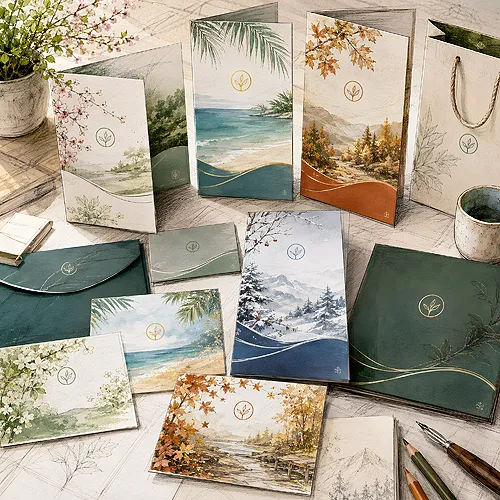
Offer folders made from recycled paper look good for presentations to institutional and corporate clients for whom sustainable development is part of their purchasing strategy. Business cards on eco paper, such as Kraftliner, build an impression based on authenticity rather than gloss. Meanwhile, brochures and leaflets made from recycled paper perform well in campaigns that directly communicate pro-ecological values, as the material becomes part of the message, not just its carrier.
It’s also worth remembering less obvious applications, such as promotional pads or tickets for corporate events, where recycled paper is often expected by organizers concerned about the environmental footprint of the event.
Frequently asked questions
Is eco-friendly paper less durable than traditional paper?
No, eco-friendly paper is comparably durable to paper made from virgin fibers. Modern recycling processes allow for maintaining high quality, which is important when producing business cards, folders, or brochures.
What certifications indicate that paper is eco-friendly?
The most commonly encountered labels are FSC, Blue Angel, and EU Ecolabel, which confirm the sustainable origin of the raw material and a responsible production process. Under EU Ecolabel, at least 25 percent of cellulose fibers must come from certified forest management.
Is eco-friendly paper suitable for printing full-color graphics?
Yes, although one limitation should be remembered: heavy printing of large, uniform surfaces may turn out less even than on coated paper. However, small elements, logos, and text print very well.
Is eco-friendly paper available in small quantities?
Yes, the availability of recycled paper in Europe is now so good that even small business card or leaflet orders can be fulfilled without problems and without long waiting times for the raw material.