Close your eyes and picture your favourite brand. You see a colour, the shape of a logo - and sometimes you also hear a short melody that plays at the end of an ad or on a hotline. That is no accident. Sound can stick in memory just as strongly as a graphic mark, and yet many companies forget about it entirely.
- We remember brands not only with our eyes - sound builds emotion and memory just like a logo.
- Sonic identity is a short motif, a consistent style of background music and a steady brand voice.
- It works everywhere: in your space, in video, on the hotline, at events and on a company carrier.
- Audio should share the same character as your logo and colours - elegant, energetic or calm.
- A small business can start by choosing a consistent repertoire and sticking to it at every touchpoint.
A brand is not only an image - it is a sound too
We are used to thinking of brand identity as something we look at: logo, colours, typeface, photo style. That is true, but it is only half the story. The other sensory route into our memory runs through the ears - and it is surprisingly effective.
Think of short sound signatures you recognise within two seconds, without even looking at the screen. A well-known jingle, a motif when a device starts up, a little melody at the end of a spot. The brain likes sound because it links it to emotion faster than an image. That is why a brand that "sounds" consistent stays in your head longer.
The good news is that you do not have to be a large corporation to benefit from this. It is enough to treat sound as seriously as looks - and to make sure the two match.
What sonic identity really is
Sonic branding sounds very technical, but in practice it comes down to a few simple elements. Each one is responsible for a different part of how a brand "sounds".
- Sound signature - a short motif, literally a few notes or one distinctive sound, that always returns in the same places. It is the equivalent of a logo, only for the ear.
- Background music style - a consistent mood and genre that accompanies the brand in your space, in films and at events. Not one song, but a recognisable atmosphere.
- Brand voice - if you use a narrator or recordings, it helps if the tone, pace and character of the voice are similar every time.
The secret is not to have all these elements at once. It lies in consistency - in the fact that in the same situations the customer hears the same thing, not something different each time.
Where brand sound really works
Sonic identity is not a decoration for a TV ad. It works everywhere the customer meets you by ear - and there are more such places than you might think.
- Space and premises - background music in a cafe, shop or salon, consistent with the brand character, sets the mood before anyone even says "hello".
- Video material - films on your website and social media gain when the soundtrack and signature are always recognisable.
- Phone and waiting room - a hold melody or a sound at reception is a micro-moment few people design deliberately, and yet it lingers in memory.
- Events - fairs, openings, presentations: the same sound keeps the brand consistent also when the customer meets it in person.
- Company carrier - a disc or pendrive with audio material is a physical object the customer takes away and which carries the brand sound further.
Audio and visual - one consistent story
The most common mistake is treating sound separately from the rest. Yet brand music should share the same character as its logo and colours. If the visual identity is elegant and understated, harsh electronica in the background will jar. If the brand is energetic and colourful, calm piano background will sound like the wrong company.
It helps to think in one keyword. Elegant, energetic, warm, calm, modern - choose the adjective that describes your brand and check whether the music fits it too. It is a simple test, and it brings a lot of order to your decisions.
A consistent brand is one you can recognise with your eyes closed - by a single sound, just as by a single colour.
The same principle of consistency governs the whole brand identity, by the way. If you want to refresh your look, you do not always have to change the logo right away - we write about building a recognisable style by other means in our piece on how to create a recognisable visual style without changing your logo.
How to start when you are a small business
You do not need a marketing department or a big budget to get going with sonic branding. A few deliberate steps and a bit of consistency are enough.
- Decide what mood your brand should have - in a single adjective.
- Choose a consistent music style or playlist and stick to it at every touchpoint.
- If your budget allows, commission a short sound motif - a few seconds that will keep returning.
- Decide where that sound appears: in your space, in video, on the hotline, on a carrier.
- Watch for consistency - better fewer elements, but always the same, than many different ones.
Start with one place your customers visit most often - for example the background music in your space or the soundtrack in your films. Set the brand sound there, and only then extend it to further points. It is easier to keep consistency step by step than everywhere at once.
A disc or pendrive - identity you can hold
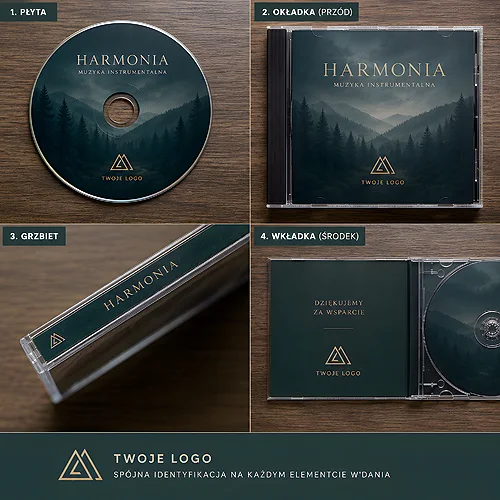
Company music does not have to live only in the cloud. A company CD with your logo printed on it or a pendrive with audio material is a physical carrier of brand identity - an object the customer receives, looks at and takes away. Sound then merges with looks in one place: the same logo, the same colours and the same character as the rest of the identity.
This works especially well when you match the music to your industry and the mood of the company. We show how to do it sensibly, with concrete examples, in our piece on how to choose music for a promotional disc tailored to your industry. A logo print on such a carrier completes the whole - the customer hears the brand and sees it at the same time.
Music and licensing - something to remember
Before you start using music in your company, make sure you have the right to it. This matters, because it covers both background music in your space and soundtracks in films or recordings on a company carrier. In practice it means using royalty-free or licensed music - that is, music you are allowed to use commercially on clearly defined terms.
It is not worth improvising here, because from a legal point of view music is an area where it is easy to make a mistake. If you would like to discuss the choice of music, the disc print or the packaging, simply get in touch - we will suggest a solution suited to your brand and advise you on what to watch out for.
The result - a brand that sounds consistent
When a brand sound is thought through and consistent, something happens that no single ad can buy. The customer starts to associate your company by ear too - linking the sound to a mood, an emotion, a specific experience. The brand stops being just a picture and becomes something you can recognise with your eyes closed.
The point is not to do it big and expensive from the start. The point is the awareness that sound is part of identity - just like the logo, the colours and the company letterhead. Start with one place, keep it consistent, and in time your brand will simply start to "sound" the way it looks.