A QR code on a flyer, a package or a sticker is a small promise. Someone reaches for their phone, points the camera at the black-and-white square and waits for a moment - and in that moment they decide whether your brand is worth their attention or the material goes aside. What the recipient finds on the other side matters far more than the mere fact that the code is there at all.
Many companies treat a QR code as decoration - they add it because it is "the done thing", and point it at the home page. Yet a person who has just scanned a code has made an active gesture. They deserve content matched to the situation, not a random address where they have to work out what it was all about. A video, an instruction, a discount, a form, a specific landing page - each of these goals delivers a different value and suits a different moment in the customer relationship. In this post we compare them one by one and show how to choose the single one that will really work.
- A QR code is an active gesture by the recipient - the content on the other side should reward that effort, not disappoint.
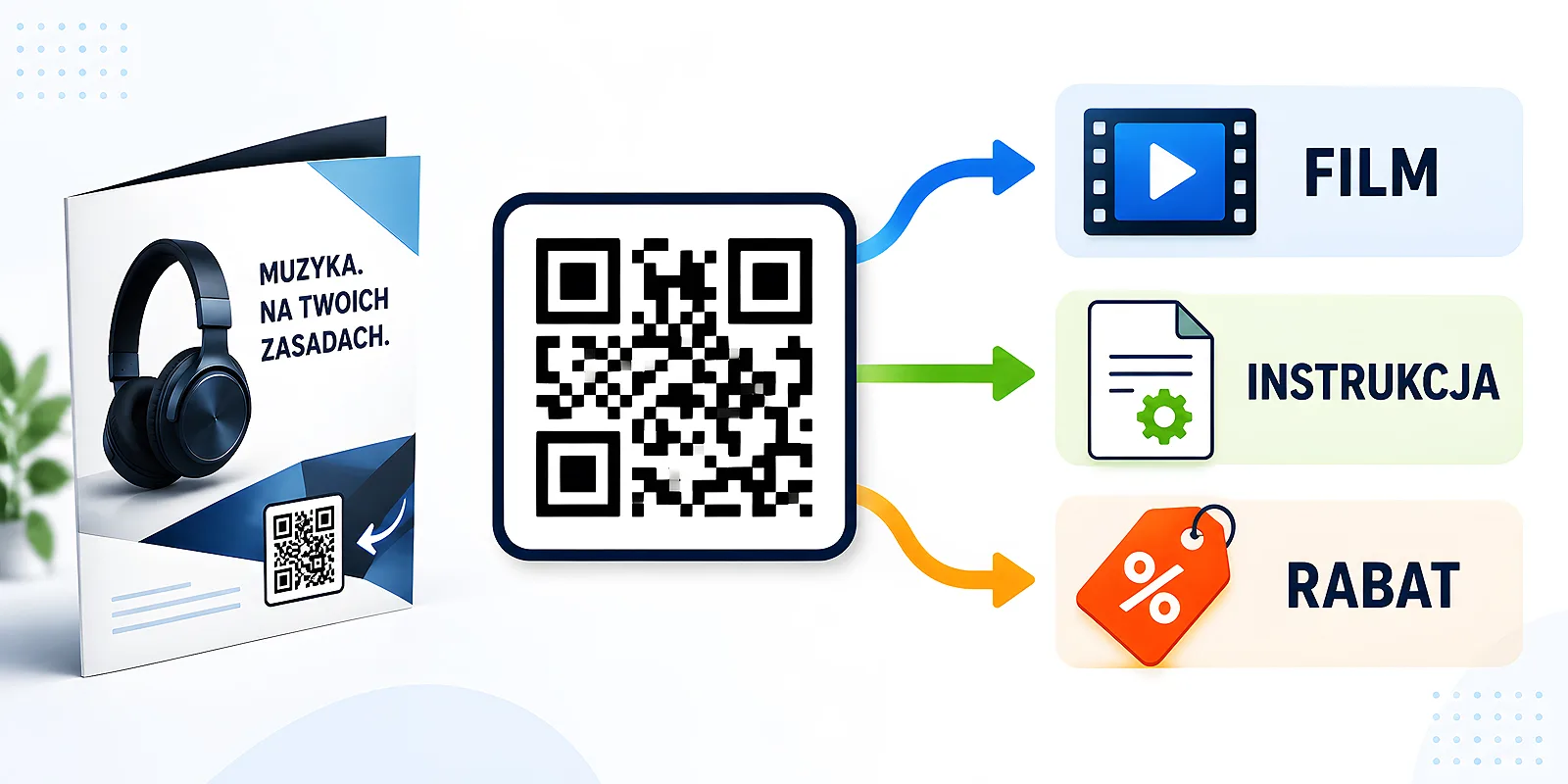
- A video builds emotion and shows the product in action, an instruction solves a specific problem, a discount gives an immediate benefit.
- Match the goal to the stage of the relationship - someone who does not know you needs something different from a regular customer.
- One clear action per code - two goals at once weaken each other.
- Every goal can be measured, so you can quickly see which type of content delivers the most.
Why the content behind the code matters more than the code itself
Scanning a code is a micro-commitment. The recipient spends a few seconds and a little trust, expecting something in return. If they land on a home page with a half-screen menu and have to guess why they are there, that exchange ends in disappointment - and next time they will not scan the code at all. That is why the first question is not "how big the code should be", but "what exactly the person who uses it will gain".
A well-planned goal answers a simple thought in the recipient's mind: it was worth it. To trigger it, the content has to fit three things at once - the material the code sits on, the moment the customer scans it, and the stage of their relationship with the brand. Let us go through the most common goals and see when each of them gives the most.
Video - when you want to show, not tell
Video works where words and photos are not enough. A short clip shows the product in motion, an assembly process, a before-and-after effect or the faces of the people behind the brand. It is the strongest carrier of emotion on the whole list - which is why it works so well when you want the recipient to feel something, not just read it.
Video does come at a cost of attention, though: it needs sound or captions and a few dozen seconds of focus. Reach for it when you genuinely have interesting material and a context where someone has a moment - a package unwrapped at home, a flyer handed out at a stand, a sticker on a product the customer is just trying out. Make sure the most important thing happens in the first few seconds, because that is all you get before the viewer decides whether to stay.
Instruction - when the recipient has a question here and now
An instruction is the most service-minded goal. The recipient has the product in hand and a specific problem: how to assemble it, how to use it, how to care for it, what to do when something does not work. A QR code leading straight to the answer saves them searching and frustration - and saves the brand a stream of calls with the same question.
This goal works best after the purchase, close to the moment of use. That is why its natural home is a package, a label, an insert in a set or a sticker on the product itself. The value here is very tangible: the customer gets help exactly when they need it. It builds trust more quietly than a video, but very durably - because it shows the brand cares about what happens after the sale.
Discount - when you want action right away
A discount is the shortest path from scan to reaction. The recipient sees the benefit at once and has a reason to move on - to place an order, return to the shop, save the code for later. It is the easiest goal to measure, because a redeemed discount is visible directly.
It has two conditions, though. First, the benefit has to be real and clear from the very first second - if after scanning the recipient still has to fill something in and search, the enthusiasm fades. Second, a discount works best when it is part of a considered mechanism rather than a random markdown slogan. We cover when a one-off coupon is better and when a repeatable tool is, in our post on a flyer with a coupon, a QR code or a loyalty card - what works.
A form and a specific page - when you are building a relationship
Not every goal has to give a reward right now. Sometimes it is about the next step in the relationship: a newsletter sign-up, booking an appointment, a post-service survey, a request for a review. A form or a dedicated landing page then lands at a natural point in the customer's journey.
There is one condition: the destination page has to be as simple as possible. One question instead of ten fields, a clear heading saying what the recipient will gain, and nothing to distract. A QR code is also a bridge between paper and the rest of the campaign - it ties a flyer, a gadget and online content into one whole. How to do this coherently we lay out in our post on how to combine print, a gadget and digital content into a coherent campaign.
Match the goal to the stage of the relationship
The same content that works beautifully on a regular customer can miss entirely with someone seeing the brand for the first time - and the other way round. That is why it is worth starting the choice of goal with a question: what stage is the person holding this material at?
- Someone who does not know you yet - a light, intriguing stimulus works best: a short video or a simple first-time discount. Do not ask for their data straight away - that is too big a step for such an early moment.
- A customer just after the purchase - here the value comes from an instruction, a usage guide or a video showing how to get the most out of the product. This is a moment for building trust, not for selling.
- A regular customer - they will appreciate a loyalty programme, a pre-sale, access to something for insiders. They know the brand, so you can ask for more - a review, a referral, a sign-up.
QR codes appear today on flyers, packaging and gadgets all at once - matching the content to the medium and the stage is a rewarding topic in its own right. We gathered it in our post on how to use QR codes on packaging, flyers and gadgets.
One clear action and a way to measure
The biggest mistake is cramming several goals into one code. An offer like "watch the video, grab the discount and sign up for the newsletter" sounds good, but it puts the recipient in front of a choice, and a choice slows things down. One code, one clear action - this is the rule that lifts effectiveness the most. If you genuinely have two different goals for two different groups, give two different codes on two materials.
Before you send the design to print, run an honesty test: look at the code and finish this thought - "after scanning, the recipient gets what exactly?" If you cannot answer in one simple sentence, the goal is too blurred - narrow it down before the material goes to paper.
Finally, something easy to forget: every one of these goals can be measured. A separate address for each code, a simple visit counter or a unique discount code show how many people actually scanned and what they did next. That way you are not guessing, but seeing which type of content works with your recipients - and you design the next material based on numbers. How to approach this without complicated tools we describe in our post on how to measure the effectiveness of campaigns with promotional gadgets.
A QR code is not magical - what is behind it sometimes is. Before you add it to a flyer, a package or a gadget, decide one thing: what exactly the person who uses it will gain. Match the video, the instruction or the discount to the material and the stage of the relationship, leave one clear action and give yourself a way to measure. Then the small black-and-white square stops being decoration and becomes a real bridge between the paper in someone's hand and what you want to give them.