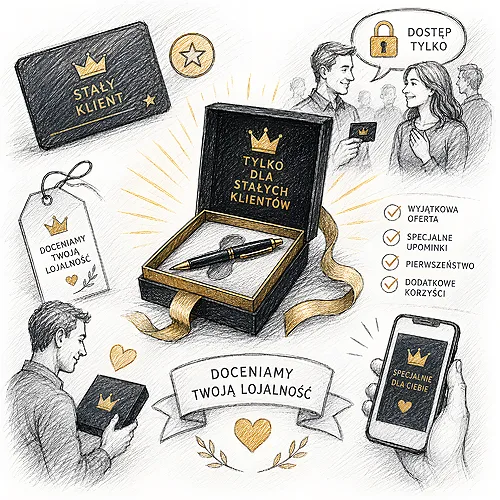
Some businesses see a client once and never again, and others see the same people over and over - every week for coffee, every six months for a service, every month at the hairdresser. The corner cafe, the dental practice, the beauty salon, the car workshop - in places like these a promotional gadget follows different rules than a flyer handed to a stranger on the street. The same person will see your brand dozens of times, and that changes the whole approach to planning.
When the relationship with a client lasts months or years, a single mug handed out at the start quickly stops making an impression. The point is not to bury people in gadgets, but to spread them out sensibly over time - so that the brand returns to the client at natural moments, rather than once and for all on the first visit.
Below we show how to plan gadgets for a business with repeat visits: from a seasonal calendar, through series instead of one-off campaigns, to budgeting in batches.
- A regular client sees the brand many times - one gadget at the start is not enough to sustain the relationship.
- Spread gadgets over time: a seasonal calendar instead of a single campaign once a year.
- Think in series - a few items tied by a shared theme work better than one random piece.
- Mix everyday practical items with occasional ones for holidays and anniversaries.
- Order in batches - a shared design and a larger run make planning and cost-spreading easier.
A regular client is a different case
Advertising handed to a stranger has one job - to stick in the memory enough for someone to remember the name at all. With a regular client, you are already past that stage. They know your business, they know where you are, they use your service. A gadget does not have to convince them that you exist - it is there to keep a warm relationship going and give a small reason to come back.
That is an important difference, because it changes what you choose. Instead of one strong accent meant to make a first impression, it is better to think about small, useful things the client keeps at hand and genuinely uses. If you are wondering which items stand the best chance of staying in daily use, take a look at our post on how to choose gadgets your clients will actually use.
A calendar instead of a single campaign
The most common mistake with regular clients is treating gadgets as a one-off campaign - order once, hand them out and the subject is closed. A simple calendar for the whole year works far better, one in which you know in advance what you want to hand out and roughly when.
It does not have to be a complicated plan. It is enough to mark a few natural moments where a gadget makes sense:
- The start of the year - calendars, notepads and pens, things that come in handy from January onwards.
- Your industry's season - a pre-winter check for a workshop, summer and mugs for a cafe, the back-to-school period for a practice.
- Holidays and the year's end - a small gift as a thank-you for a whole year of working together.
- Anniversaries and company occasions - the venue's birthday, a round number of years in business, a reopening after renovation.
Such a spread means the brand returns to the client several times a year, and each gadget has its moment and context, rather than landing in a drawer "for someday".
Map out your gadget calendar in the same place where you plan your other company activities. When you see the whole year at once, it is easier to spread spending evenly and avoid the situation where, in December, you realise you have nothing to thank your regular clients with.
Think in series, not single pieces
A single gadget is easily lost. A series - a few items tied by a shared idea - builds a coherent picture of the brand and gives the client the sense that a considered whole stands behind it.
A series does not mean everything has to be identical. It is about a common denominator: the same colour palette, the same way of placing the logo, a recurring detail or slogan. A mug, a pen and a notepad in one style look like a set right away, even if you hand them out in different months.
A well-chosen series has one more advantage - adding further elements is easy. Once you have a set shared style, adding a keyring or a bag in the same aesthetic is a formality, not a project from scratch.
Mix practical items with occasional ones
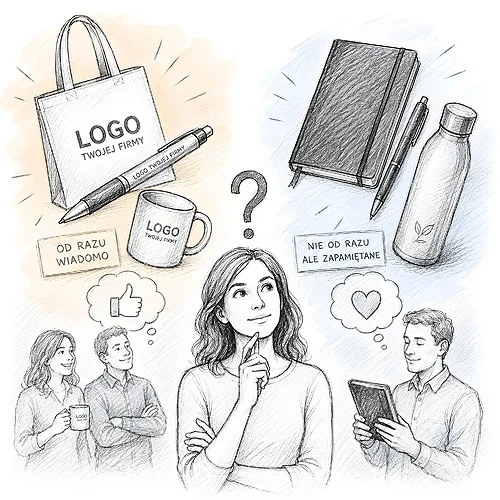
A well-planned series combines two kinds of gadgets. The first is practical items the client uses every day - and which keep the brand within sight along the way. The second is occasional gadgets, handed out more rarely, at holidays or on special occasions, where the gesture matters more than everyday function.
- Practical - pens, notepads, mugs, magnets, keyrings. Inexpensive per piece and great for handing out regularly.
- Occasional - more carefully finished items for holidays or anniversaries, where the impression counts rather than the number of pieces.
Mixing the two groups keeps the relationship from becoming monotonous. Everyday items keep the brand in the background, while rarer gifts give it a stronger accent now and then. If you are working on a modest budget, a good starting point is our post on what to order on a limited budget.
Brand consistency and how not to bore
Repetition builds recognition, but repeating the exact same thing too literally can grow tiresome. The trick is to keep the brand's motif recognisable while making it feel a little fresh each time.
A few simple rules help here. Keep the constants - logo, colours, typeface - and change what surrounds them: the type of item, the slogan, a small graphic detail for a given season. That way the client still sees the same brand but does not feel they are getting the same gadget over and over.
It is also worth thinking about where the gadgets end up on display - at reception, on the counter, at the point of sale. How to do this without being pushy is something we describe in our piece on gadgets at reception and the point of sale without pushy advertising.
Budgeting in batches
Planning ahead pays off on the budget side too. Instead of buying single pieces in a hurry, it is worth ordering in batches - a larger run of one design is usually more cost-effective, and a shared graphic file saves time with every following delivery.
- Map out the whole year - roughly how many pieces and which items you need for the upcoming moments on the calendar.
- Combine orders - if several gadgets share the same design, order them together rather than splitting into small deliveries.
- Leave a margin - new clients appear all year round, so a slight surplus is rarely wasted.
- Keep the design in one place - a ready, approved file lets you add another batch without repeating all the work.
This approach means gadgets stop being a sudden "because we have to" expense and become a predictable, time-spread part of staying in touch with the client.
A business clients return to has a huge advantage - it does not have to fight for attention from scratch every time. It is worth treating promotional gadgets the same way as that relationship: not as a one-off shot, but as a series of small, considered gestures spread across the whole year. Set the calendar, choose a coherent series, mix the everyday with the occasional - and the brand will return to the client naturally, warmly and without feeling like pushy advertising. If you want to be sure that none of these small items ends up in a drawer, take a look at our post on how to create a company gift that will not end up in a drawer. For ready ideas, browse our range of promotional gadgets.