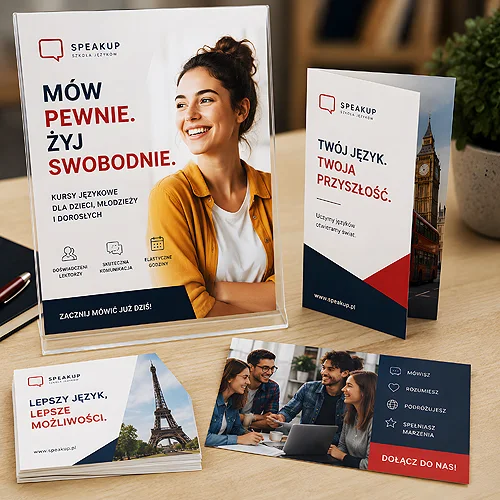
Every company has stories in a drawer that sell better than the best flyer - only nobody tells them. The job that looked impossible, the customer who came back after years, the project that started with a phone call at an odd hour. These are ready-made promotional materials, only in raw form. All you have to do is tell them.
A case study, meaning a description of a real project or collaboration, is one of the most convincing kinds of content. It does not say "we are good", it shows it with a concrete example. The customer does not have to take your word for it - they see what the road from problem to result looked like. And because the story is about real people, it is easier to identify with than a list of advantages.
The trouble is that the phrase "case study" sounds corporate and intimidating. Yet it is not about a multi-page report, but about a well-told story - the kind you would tell a friend over coffee. In this post we show how to turn a project into an engaging piece for a flyer, an offer folder or a catalogue, without bragging and without making things up.
- A case study is simply a well-told story: the starting point, what you did, what the result was.
- The most interesting project is not always the biggest - often it is the one with a clear problem and a tangible change.
- Real-life photos and a customer quote turn a dry description into a credible story.
- You will lay out the same material differently for a flyer, an offer folder or a catalogue.
- Tell it modestly and truthfully - a specific convinces more strongly than self-praise.

What a case study really is - and why not to fear the name
Let us set aside the corporate associations. A case study is simply the story of one project told so that the reader sees themselves in it. It has a hero, meaning your customer, it has a problem to solve, and it has an ending in which the problem disappears. That is it. You do not need charts or jargon for this - you need honesty and order in the telling.
The strength of this form comes from the fact that instead of promising, it shows. "We make high-quality offer folders" is a declaration. "The customer came to us the day before an important meeting empty-handed, and left with a complete set of materials that impressed his business partner" - that is proof. A good story, like good advertising, starts from the audience's problem rather than from praising yourself - we develop this in our post on why good advertising starts with the customer's problem.
A structure that tells itself
The simplest and most effective case study structure has three parts. If you stick to them, you will not lose the thread or bore the reader.
The starting point - what the customer came with
Start with the situation the customer found themselves in. What they needed, what nagged at them, what deadline or constraint they had. This is the most important part, because it is here that the reader recognises their own problem. The more concretely you describe the starting point, the more strongly you draw them in.
What you did - without boring detail
Describe how you approached the matter, but choose only what matters to the story. Do not list every step. Show the decisions that changed something: a tip about the format, the choice of a thicker card, preparing the design in a few versions to choose from. A specific builds an impression of competence better than the generality "we took care of everything".
The result - what changed
Close the story with a tangible change. It does not have to be a big number - sometimes it is enough that the customer made it to the trade fair, came back with another order, or that their materials finally looked coherent. The result is the moment when the reader thinks "I want that too".
How to choose the project worth telling
Not every job is suited to a story - and that is fine, because it is not about quantity. Look for a project that has tension and a clear change in it. Four questions help:
- Was there a clear problem or challenge at the start? A story without a problem is dull.
- Is the change tangible and easy to show? You prefer "they made the deadline" to "they were satisfied".
- Will the customer agree to appear with a name or company? A concrete hero means greater credibility.
- Does this story concern a problem others have too? Then it will reach a wider audience.
The biggest project is not always the most interesting. Often a smaller but vivid job with a clear "before" and "after" works more strongly.
Real-life photos and the customer's voice
The content itself is the skeleton - photos and a quote are what make the story alive.
Photos that show the truth
A photo of the finished materials in the customer's hands, at their stand or on their desk says more than a description. They do not have to be studio shots - natural, real-life frames match the honest tone of a case study and build trust. What matters is that they are sharp and clear, because they are the first thing to catch the eye.
The customer's quote as a seal
One honest sentence from the customer can close the whole story. "I did not think it could be done in time - and yet" weighs more than a paragraph of your description. Always ask for consent to publish and sign the quote with a name and context. The voice of the hero themselves lends credibility to everything you wrote earlier.
Gather material for the story as you go, during the project, not after the fact. Take a few photos on your phone, note down one sentence the customer said, write down what the challenge was. Once the job is finished, these little things can be impossible to recreate, and it is exactly they that make a case study real.
How to translate the story into a specific material
The same story looks different on each medium. Match the form to the space and length:
- A flyer - one story in a nutshell: a short description of the problem, a photo of the result and a quote. A classic flyer works brilliantly as material handed out after a meeting. A case study is typically image content rather than sales content - we describe the differences in our post on how a product flyer differs from an image flyer.
- An offer folder - a natural place for a longer version with several photos. The customer browses an offer folder at their leisure, so you can develop the thread. One strong story on a separate card inside works well.
- A catalogue or a poster - here brevity counts. A poster fits one photo and one result sentence; a catalogue - a short "customer story" box next to the relevant product. The skill of cutting comes in handy at every step, which is why it is worth looking at our post on how to shorten advertising copy to make it convincing.
The rule: the less space, the more firmly you have to choose one thread instead of telling everything - and how to find that one thread, we suggest in our post on how to find one strong message instead of talking about everything.
Without bragging and without making things up
A case study has a thin line that is not worth crossing. On one side there is the temptation to brag - to describe yourself as the hero who saved everything. On the other, the temptation to tweak the facts so the story sounds better. Both end the same way: the reader senses the falseness and stops believing.
The real hero of the story is the customer, not you. Your role is the capable helper who solved the problem - and that is enough. You do not have to embellish the result or add in numbers that were not there. A modest, concrete story about a real change convinces more strongly than the most spectacular but stretched tale. If something did not happen - simply do not write it.
A good project story does not need a big budget or a marketing department - it needs attention and honesty. Catch the moment when you helped a customer out of trouble, describe it simply in three steps, add a real-life photo and one sentence of theirs. That is how you create material that sells without selling - because instead of promising, it simply shows that someone has already succeeded.