The most effective advertising is often the kind no one treats as advertising. The mug you drink your morning coffee from. The pen you sign with ten times a day. The keyring in your pocket from morning till evening. These items do not shout, do not interrupt, do not demand attention - and yet the company's logo drifts past the owner's eyes every day, week after week, without a single coin spent on media.
That is exactly what sets an everyday-use gadget apart from ordinary advertising. A paid banner or spot works only as long as you keep paying for it. A well-chosen item works on its own - for months, in the background, alongside ordinary tasks. The secret lies in one word: usefulness.
Below we show why advertising woven into daily habits is so effective, how to match a gadget to the recipient's daily rhythm, and why durability and print determine how long such an item works for the brand.
- A gadget woven into a daily routine shows the brand many times, at no media cost.
- Usefulness is key - an item someone genuinely uses stays; a decoration ends up in a drawer.
- The more often a gadget is in someone's hands, the longer and more effectively the logo works.
- Match the item to the recipient's daily rhythm - one gadget for the office, another for someone on the move.
- Durability and a good print decide how long the gadget stays in use.
Advertising that does not interrupt
Most advertising works through interruption. A banner covers the content, a spot cuts into the middle of a film, an email lands in the inbox uninvited. An everyday-use gadget works the other way round - it interrupts nothing, because the recipient reaches for it themselves. They pick up the mug because they want a drink. They grab the pen because they need to sign something. The brand appears along the way, in the background, without any sense that someone is trying to sell.
That is exactly what makes such a gadget so well received. It does not fight for attention - it is simply at hand at the moment it is needed. The principle itself is simple: an ordinary everyday product can become an advertising carrier, as long as it is genuinely used.
Why daily contact with the brand works
Television or online advertising charges for every airing. You pay for a gadget once - when you order it - and then it works for months, with no extra charge for each appearance. A mug sitting on a desk shows the logo several times a day for a whole year. Per single contact with the brand, it is hard to find a cheaper carrier.
On top of this comes a mechanism psychologists call the mere-exposure effect - the more often we see something neutral, the more familiar it becomes and the more we come to trust it. A brand that is within sight every day stops being a stranger. When the moment of a buying decision comes, we more readily choose what we know - and we know what we have at hand every day.
Before you choose a gadget, picture a single day in the recipient's life. At which moment will they reach for the item? If you can point to a specific moment - the morning coffee, a note in a meeting, the keys on the way out - you have a good gadget. If you cannot see such a moment, the item will probably end up in a drawer.
Usefulness matters more than decoration
A decorative gadget pleases the eye for a moment and then lands on a shelf. A useful gadget stays in circulation, because it solves a small, recurring problem - you need to write something down, open a bottle, charge a phone, transfer files. It is usefulness, not looks, that decides how long the item works for the brand.
That is why, when choosing, it is worth asking not "is it pretty" but "will anyone use it". A pretty keyring that does nothing loses out to a simple, solid one that actually holds keys. We develop this theme in our post on why a gadget's usefulness matters more than a low price.
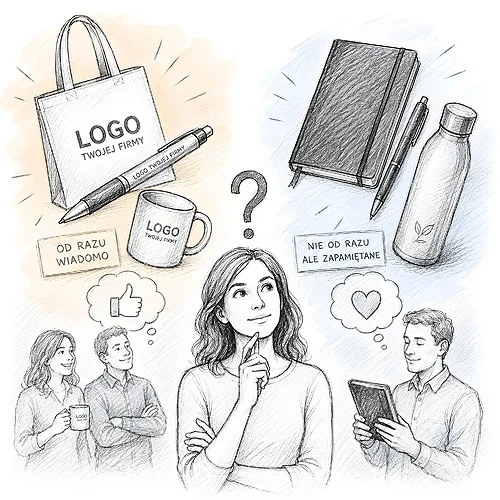
The best-working everyday items include:
- Pens - they reach the hand many times a day, in the office and beyond it.
- Mugs and bottles - they accompany the morning coffee and work at the desk.
- Notepads and pads - they lie at hand in meetings and in everyday planning.
- Keyrings - they are by the keys from morning till evening, practically every day.
- Flash drives and chargers - they return to the hands whenever files need moving or a phone needs topping up.
Match the gadget to the recipient's daily rhythm
Not every recipient has the same day. Someone spends it at a desk, someone on the move, someone in contact with clients. A good gadget hits that rhythm rather than working alongside it.
- Desk work - a mug, a notepad, a pen, a mouse mat. Things within reach throughout the working day.
- Someone on the move - a bottle, a keyring, a power bank, a charger. Items carried around and used away from the office.
- Contact with people - pens and small items easy to pass on, handing the brand to further people.
The better a gadget fits the recipient's particular day, the more often it lands in their hands - and each such reach is another, free contact with the brand.
Durability and print - how long the gadget works
An everyday-use gadget works only as long as it stays functional and legible. A cheap item that breaks after a week, or whose print rubs off, disappears from circulation and takes the brand with it. That is why, for things meant to be used daily, durability is key. Among pens, laser engraving on metal lasts longest - on the COSMO, our most popular metal model, the mark is formed in the aluminium barrel, so there is no layer of ink to rub away.
Two things matter most: the quality of the item itself and the durability of the branding. A solid metal pen will last far longer than the cheapest plastic, and a logo applied by a durable method - a rub-resistant print or engraving on metal or a flash drive - will not wear off after a few weeks. On a keyring, a hard-wearing print or doming works well - that is, a raised, protected sticker. Which items best withstand daily use is something we write about more fully in our post on which promotional gadgets are the most durable.
It is also worth remembering that durability only makes sense when the item is genuinely used. The best print on a flash drive will not help if no one reaches for it. So before you bet on build quality, make sure you are choosing an item your recipients will actually use.
Advertising that someone willingly holds in their hand every day does something you cannot buy with any media budget - it becomes part of someone's routine. A mug, a pen, a notepad or a keyring do not interrupt, do not irritate, do not demand attention. They are simply there, day after day, quietly reminding of the brand at the best possible moment - when they turn out to be useful. Choose items that are useful, matched to the recipient's daily rhythm and made to survive everyday use - and one well-thought-out gadget will work for you longer than many a paid campaign.