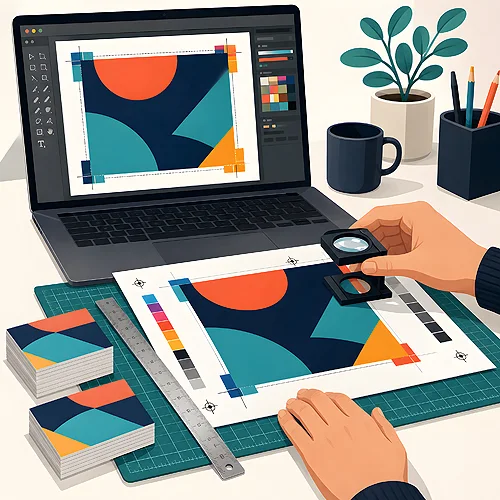
Choosing paper and colours is only half the decision. The other half is the finish - a thin film (laminate) applied over the finished print. It is what makes the same design shine and bring photos to life one moment, and look muted, elegant and velvety to the touch the next. The three most common options are gloss film, matte film and Soft Touch. Below we compare them plainly, so you know which one suits your brand.
- Gloss film deepens colours and contrast - great for photos and vivid graphics, but it reflects light and picks up fingerprints.
- Matte film is muted and modern, less shiny and pleasant in the hand; colours are slightly toned down.
- Soft Touch is a velvety laminate, very premium and deeply matte - more sensitive to scratches and greasy marks.
- The laminate affects not just the look, but also the feel, stiffness and protection of the paper.
- The "wow" effect comes from pairing Soft Touch with a ready shape - rounded corners are available on loyalty cards, bookmarks and beer mats, while hang tags and door hangers come in ready die-cut outlines.
Why laminate a print at all
Laminate is not only about looks. It is a protective layer that genuinely extends the life of a print. It shields colours from rubbing, protects against moisture and light soiling, and adds stiffness to the paper - a laminated business card does not bend as easily as a bare one.
There is also the impression of quality. A card you pick up communicates something before anyone reads a word. A smooth, pleasant surface says "this was made with care" - and that is exactly the point of most company materials.
Gloss film - vivid colours and strong contrast
Gloss film brings colours to life and deepens them. Colours become more intense, blacks deeper, and the whole thing gains a "fresh", energetic character. It is the best choice wherever a rich image matters.
- Best for: product photos, vivid graphics, promotional flyers, covers, materials meant to catch the eye with colour.
- Strengths: maximum contrast and saturation, a fresh look, good surface protection.
- Keep in mind: a glossy surface reflects light, so under a lamp or sun you may get glare. Fingerprints show too - especially on dark, solid backgrounds.
If your design lives on colour and photography, gloss film will pull the most out of it. With large dark areas, though, it is worth considering matte to avoid visible touch marks.
Matte film - elegance and calm
Matte film goes the opposite way. Instead of shine it gives a smooth, muted surface with no glare. Colours are a touch more subdued than on gloss, but the whole thing reads as modern, calm and "more expensive".
- Best for: business cards, folders, catalogue covers, materials for brands that want to look elegant and serious.
- Strengths: no glare, pleasant to the touch, easier to read text under artificial light, fingerprints less visible than on gloss.
- Keep in mind: intense, "loud" colours will be gently toned down - if you want maximum saturation, gloss wins.
Matte is a safe, versatile choice for companies. It looks great on classic business cards and on company folders, where a calm, professional image counts.
Lots of text to read? Choose matte. A matte surface does not reflect light, so the eye does not fight glare and letters read more comfortably - especially in the office under a lamp.
Soft Touch - velvet to the touch
Soft Touch is a laminate you recognise before you even look. The surface is exceptionally soft and smooth - a bit like suede or a peach. It is the most "premium" feel of all three films, which is why it is often chosen by higher-end brands.
- Best for: exclusive business cards, premium invitations, cosmetics packaging, covers - anything meant to impress the moment it is held.
- Strengths: a unique, velvety touch, deep matte colours, a very elegant, luxurious feel.
- Keep in mind: the soft surface is more sensitive to scratches and greasy marks. That is why Soft Touch looks best where the shape is already set - on loyalty cards with rounded corners or on bookmarks with an asymmetric corner.
Soft Touch is the choice for brands that want their material to stick in memory not only by its looks, but by its feel. It is one of those finishes that is hard to describe - you have to feel it.
What the laminate really affects
When choosing a film, you usually think about the look. It is worth remembering, though, that the laminate changes several things at once.
- Look: gloss boosts colours, matte quiets them, Soft Touch gives a deep, velvety matte.
- Feel: from the smooth, "cold" gloss, through a pleasant matte, to the suede-soft Soft Touch.
- Durability and protection: every film protects paper from rubbing and moisture; gloss handles marks best, Soft Touch is the most delicate.
- Stiffness: laminated paper is stiffer and holds its shape better, which helps on business cards and covers.
In other words: this is not just a "nicer finish". The laminate helps decide how the material ages and how long it keeps looking good.
The contrast effect - standing out with shape
If you want to truly surprise people, combine a laminate with a custom shape. On a matte or Soft Touch background a ready shape looks great: a loyalty card 85×55 mm with rounded corners, a bookmark with a rounded or asymmetric corner, a beer mat as a circle, hexagon or rosette. We do not cut custom outlines - the shape is picked from a ready list. A contrast appears: a velvety, calm surface paired with an unusual, memorable silhouette.
This works in two ways. Visually - the unusual shape instantly sets the material apart from standard rectangles. By touch - fingers feel both the softness of Soft Touch or the calm of matte, and the cut edge of a hang tag or the gentle curve of a rounded corner. It is one of the most striking ways to make a business card or cover look expensive and considered.
How to choose a film for your project
There is no single "best" film - there is the best film for a specific goal and brand. A few simple pointers make the decision easier.
- Lots of photos and vivid colours? Go for gloss film - it pulls the most out of the image.
- Elegance, calm, lots of text? Choose matte - versatile, readable and professional.
- A premium brand, first touch matters? Soft Touch, and where the product allows it, with rounded corners for extra character.
- A material handled a lot, dark backgrounds? Avoid bare gloss on large dark areas - matte hides the marks.
It is also worth remembering that the laminate plays in tandem with the paper. The same design turns out differently on a thin sheet and on a thick, stiff one - which is why we cover choosing the stock for different materials separately in the piece on how to choose paper for a flyer, business card, invitation and catalogue.
Summary
Gloss, matte and Soft Touch film are three different characters of the same idea - protecting and finishing a print. Gloss brings colours to life, matte calms things down and adds elegance, Soft Touch impresses the moment it is touched. Think about what your material should do: draw the eye with colour, look serious or delight in the hand. The answer to that question leads straight to the right film - and if you are in doubt, we will happily help match the finish to a specific project.