
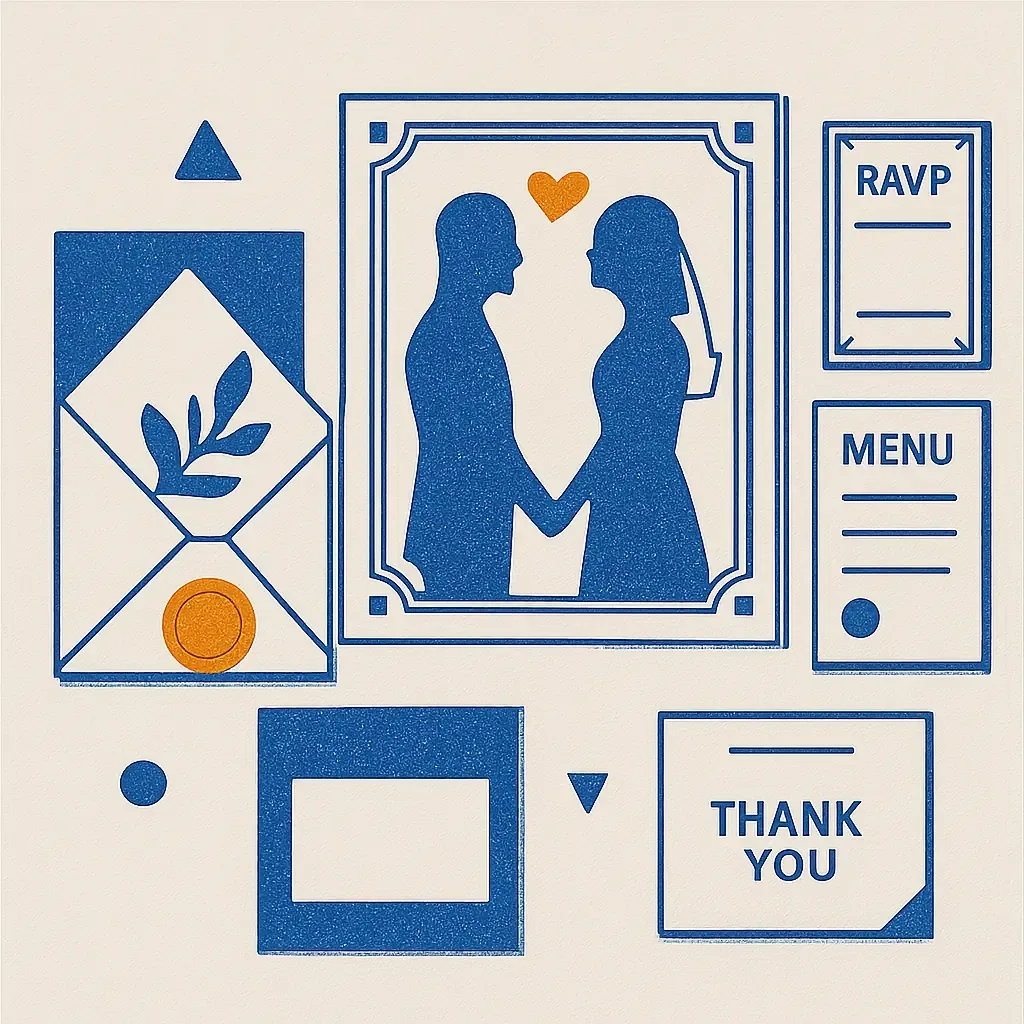
The invitation, place card, and napkin on the wedding table should look as if they were designed by one hand. However, many couples first choose invitations, and only later, in the last month before the wedding, remember about place cards or thank you notes, which later become hard to match color-wise. This text shows how to plan wedding stationery as one cohesive printed project, not a collection of random additions.
- Invitations - sent out 4-6 months before the wedding, establish the color scheme and typography for the entire stationery.
- Place cards and menu - ordered 1-3 months before the wedding, when the guest list is already closed.
- Chair and alcohol tags - a small but visible detail that completes the stylization of the table.
- Thank you notes and table cards - personalized elements that guests take home.
- One base paper - the simplest way to make the entire set look cohesive, even when ordered in batches.
1. Wedding invitations as the first element of cohesive stationery
Wedding stationery is a complete set of printed materials that sets the stylistic tone for the entire ceremony: from invitations, through place cards and menus, to welcome boards and alcohol tags. The invitation is the starting point in this set, as it is the first to reach guests and it determines the color scheme, typography, and graphic theme that is then repeated in subsequent elements.
From a scheduling perspective, it is best to send out invitations 4-6 months before the wedding, which means that the design and printing need to be commissioned even earlier. This is not an excessive caution: with custom formats, intricate shapes, or additions like wax or string, production time lengthens, and graphic corrections can take several weeks. Just like when planning other corporate materials in advance, for example, when choosing a company calendar for the next year, it is advisable to plan the printing schedule in advance, rather than working under deadline pressure.
Prices for simple invitations in specialty stores start at around 3 PLN each. More elaborate versions, with vellum, golden string, or wax, cost between 11 and 25 PLN each, which makes a difference in the budget with a hundred envelopes. It is also worth knowing that minimalist invitations are sometimes printed on unique Italian paper weighing 300 g with a texture coming from recycling, while premium versions are printed on black paper weighing 400 g, which gives a deep, elegant black effect under gold or white foil printing.
When designing the invitation, it’s good to think about the entire set right away: the same font on place cards, the same shade of gray or green on thank you notes. This saves time on subsequent orders and eliminates the risk that a menu looking different from the invitation will ruin the table's aesthetics.
2. Place cards, menus, and chair tags: details that make a difference
Place cards, menus, and tags are elements that often end up at the very end of the shopping list, yet they are the ones that stand out the most during the wedding itself. Guests sit at the table, look at the place card with their name, at the menu card, at the tag by the glass, and this builds the first impression of the room.
The prices for wedding place cards vary greatly, from a few dozen groszy each to several dozen PLN, depending on the design and finish. A standard place card with design and printing typically costs around 1.95 PLN each, while with embellishment, such as gold foil, the price rises to about 2.95 PLN. Versions in the format 105 x 60 mm with a wooden base cost around 3 PLN each, and those with hand-applied gold can reach even 6.5 PLN. With a hundred guests, the difference between the basic version and the hand-gilded one becomes noticeable, so it’s worth calculating this before the design goes to print.
The wedding menu should be matched to the table format and the number of dishes: a single sheet works well for a short menu, while a folded format suits an extensive service with several courses and dessert. Paper with a higher weight, above 250 g, ensures that the sheet does not bend under touch and lies flat on the tablecloth.
Chair tags and alcohol bottle tags are a small cost relative to their visual effect. By repeating the same design as on the invitation, such as a small floral pattern or the couple's monogram, the whole table starts to look like one, thought-out project, not a collection of random additions bought in different places.
Place cards, menus, and tags are usually ordered 1-3 months before the wedding, when the guest list is already closed. Ordering these elements earlier often results in the need for corrections, as someone might cancel or add themselves at the last moment.
3. Thank you notes for guests and personalized table cards
Thank you notes for guests are elements that a guest takes home, so it’s worth ensuring they well represent the entire wedding's style. Thank you cards in the format of 5x5 cm, printed on 350 g coated paper, cost around 1.50 PLN each, while the version with gold foil embellishment is around 2.25 PLN. Broadly speaking, the entire category of thank yous for wedding guests typically ranges from 3 to 10 PLN each, depending on the form: card, sachet with tea, or label on a jar of honey.
Table cards, which are personalized seating instructions, are one of those details that are easily overlooked, but which genuinely facilitate the wedding's logistics. Instead of searching for their seat blindly, a guest can immediately see their name and table number. A well-designed table card echoes the typography from the invitation and place card, ensuring the entire visual flow from the envelope to the table is cohesive.
It’s also worth considering a guest book, which, although not formally a table element, often stands next to the thank you notes and is one of the last elements of stationery added to the set. A book in the format 22x23 cm, consisting of 50 pages weighing 120 g, stitched like an album and covered with canvas, costs around 95 PLN, while the version in the format 30x22 cm is about 105 PLN. This is a small expense compared to the rest of the wedding budget, and it leaves a keepsake for years.
When designing these elements, it’s good to physically line them up next to each other before sending them to print: invitation, place card, table card, and thank you note. If something looks off color-wise after laying them side by side, it’s easier to fix it at the file stage than after receiving the finished copies.
4. How to choose paper and finish for the wedding style?
The choice of paper for wedding stationery primarily depends on the style of the wedding, and not on random taste from one online store. A rustic outdoor wedding calls for eco paper with recycling texture, weighing around 300 g, without shiny additions. A glamorous wedding looks better on 400 g black paper with gold or silver foil printing. A minimalist Scandinavian wedding often presents best on smooth, matte paper without any additional effects, where the entire weight of aesthetics rests on typography.
How to choose paper and finishing step by step:
- Determine the style of the wedding: rustic, glamour, minimalist, classic.
- Choose one base paper, like 300 g eco or 350 g coated paper, and stick with it throughout the entire set.
- Decide on one leading embellishment: gold foil, spot gloss, or embossing, instead of mixing several techniques at once.
- Plan the order of orders: first invitations, then place cards and menus, and finally thank you notes and guest book.
- Compile samples physically before the final order of the entire run.
Embellishments such as vellum, gold string, or gloss raise the unit cost, but they also significantly affect how the set looks and feels in the hands of guests receiving the envelope. On the other hand, too many different techniques in one set, such as gold foil on the invitation, silver gloss on the place card, and embossing on the thank you note, make the whole begin to look chaotic, despite good design intentions. Simplicity in choosing finishes often yields a more elegant effect than a plethora of special effects. If the set is to be printed in batches over several months, it’s good to record the exact parameters of the paper and colors used in the first order, so that in subsequent orders one does not rely on memory.
Frequently asked questions
When to order wedding stationery to meet the deadline?
It is best to commission invitations so that they can be sent out 4-6 months before the wedding, which means starting work on the design even earlier. Place cards, menus, and the remaining elements are usually ordered 1-3 months before the wedding, when the guest list is already closed.
Does the entire stationery set have to be printed at one print shop?
It does not have to, but it simplifies keeping color and paper consistency. If elements are ordered in different places, it’s worth providing precise paper parameters and colors from the first order to avoid differences that are visibly obvious.
How much does complete wedding stationery realistically cost?
The cost depends on the number of guests and chosen embellishments. Invitations usually range from 3 to 25 PLN each, place cards from about 2 to 6.5 PLN, and thank you notes from 3 to 10 PLN each, so with a hundred guests, it’s worth breaking down the budget for individual elements before placing orders.
Is it worth designing wedding stationery by oneself?
One can, if they have graphic experience and time for print tests. However, it is safer to at least commission the determination of the technical parameters of the files to avoid color discrepancies between the screen and the printout.
Summary: three variants that work best
If one direction for the entire set must be chosen, three variants come up most often. The first is the eco set: recycled 300 g paper, without shiny additions, calm typography, suits outdoor and rustic weddings. The second is the premium set: black 400 g paper, gold foil on the invitation, place card, and thank you note, fits glamour weddings and evening receptions in elegant interiors. The third is the minimalist set: smooth, matte paper, one font, no additional techniques, for couples who prioritize simplicity and readability over spectacularity.
Regardless of the chosen direction, the key to consistency lies in the order of actions: first the invitation sets the tone, then the subsequent elements repeat it, not the other way around. This is a simpler approach than selecting each element individually and hoping that everything will come together in the wedding hall.


